Dernère mise à jour -
Gouvernement de Côte d’Ivoire
Conférences présidentielles de l’OMC
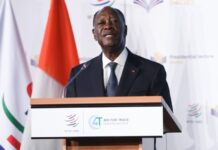
“Pour les pays en développement, la re-globalisation représente une occasion de dépasser leur spécialisation traditionnelle dans l’exportation de produits primaires et de prendre une place plus importante dans les activités d’innovation, de transformation, de production industrielle et de commercialisation.” Tel était le message clé de S.E. Alassane Ouattara, Président de la Côte d’Ivoire, qui s’est exprimé le 29 octobre dans le cadre de la série des Conférences présidentielles de l’OMC.
Re-globalization is a process in which globalization is made broader, more resilient and more inclusive. President Ouattara noted Director-General Ngozi Okonjo-Iweala’s call for a focus on re-globalization, and emphasized such an effort requires improving infrastructure, developing skills, facilitating access to financing and promoting technology transfer.
Re-globalization also requires coherent public policies, strengthened international cooperation and having trade rules that enable the most vulnerable countries to better seize the opportunities offered by the global economy, said President Ouattara. The aim is to enable developing countries such as Côte d’Ivoire to move from focusing primarily on the export of raw materials to targeting value creation, competitiveness and productive transformation, the President added.
The experience of Côte d’Ivoire provides a concrete example of this ambition, he said, noting that the country achieved sustained economic growth of 7 per cent on average between 2012 and 2025 despite shocks such as the COVID-19 pandemic. This period was characterized by significant growth in trade, a gradual diversification of markets and a consolidation of Côte d’Ivoire’s production capacity based on an improved business climate, strengthened governance, a sound macroeconomic framework and sustainable debt management.
President Ouattara said African regional integration also represents a major opportunity to further achieve this ambition. Businesses need sufficiently large markets to achieve economies of scale, recoup their investments and improve their competitiveness.
In this regard, the African Continental Free Trade Area (AfCFTA) serves as an important lever for expanding market opportunities for Ivorian businesses, facilitating trade and fostering the emergence of regional value chains, President Ouattara said.
In her welcoming remarks, DG Okonjo-Iweala noted the global trading system is currently going through a difficult period and that African economies in particular face uncertainty and fragmentation in accessing external markets.
Yet, amidst these challenges, there are promising opportunities for Africa to use trade as a driver of growth, development and job creation, she said, noting that several African countries, including Côte d’Ivoire, have recorded some of the highest growth rates in the world in recent years.
To seize these opportunities, however, leadership and policy change at the national level are essential. These domestic efforts must also be complemented by reforms undertaken elsewhere, including at the WTO, the Director-General added.
OMC